




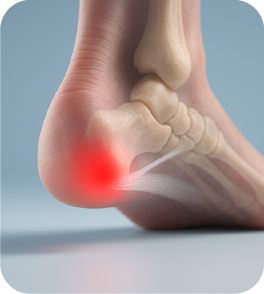
Not all heel pain is plantar fasciitis.
Understanding the spectrum of heel pain conditions helps pharmacists deliver targeted advice, recommend appropriate products, and identify red flags requiring referral.
Common causes of heel pain: how to tell them apart?
Condition | Where is the pain? | Typical features | “Clue” that helps you spot it |
Mid-portion Achilles tendinopathy | Tendon, above the heel | Worse with load; stiffness | Tender, thickened tendon; pain with heel raises |
Insertional Achilles tendinopathy ± retrocalcaneal bursitis | Back of the heel (insertion) | Worse with shoes or uphill walking | Shoe counter irritation; insertion tenderness |
Heel fat pad syndrome | Central plantar heel | Worse on hard floors or barefoot | Deep “bruised” heel pain; less morning first-step pain |
Calcaneal stress fracture | Heel bone (often focal) | Progressive pain; may occur at rest or night | Recent load increase; focal bony tenderness |
Tarsal tunnel / nerve entrapment | Medial heel → sole | Burning or tingling; worse with standing | Neuropathic pain (tingling, numbness) |
Inflammatory enthesitis (SpA) | Achilles or plantar insertions | Morning stiffness; often bilateral | Back pain, psoriasis, inflammatory bowel disease, uveitis |
Posterior heel pain: Achilles-related disorders
Achilles tendinopathy is a common cause of posterior heel pain, particularly in running or jumping sports and in middle-aged adults after a recent increase or change in physical activity. Pain is typically localized to the tendon (mid-portion) or its insertion on the calcaneus, worsens with activity, and may be accompanied by morning stiffness 2-4.
Insertional Achilles tendinopathy may be worsened by shoe pressure and may coexist with adjacent conditions such as retrocalcaneal bursitis or a Haglund-type prominence. From a pharmacy perspective, relevant advice includes avoiding compressive footwear, temporarily reducing provocative activities, and encouraging referral for exercise-based rehabilitation when symptoms persist 2, 4, 5.
Central plantar heel pain: heel fat pad syndrome
Heel fat pad syndrome (HFPS) is increasingly recognized as a distinct cause of plantar heel pain and may be overlooked when all plantar pain is assumed to be plantar fasciopathy. Patients often describe deep, bruise-like pain in the centre of the heel, often worsened by prolonged standing, barefoot walking, or hard surfaces 6, 7.
Management is primarily mechanical offloading, including cushioned footwear, heel cups, viscoelastic inserts, and activity modification 6.
Calcaneal stress fracture
Neuropathic heel pain: tarsal tunnel and calcaneal nerve entrapment
Inflammatory and systemic causes: spondyloarthritis (enthesitis)
Heel pain may reflect enthesitis, defined as inflammation at tendon or ligament insertions.
In spondyloarthritis (SpA), enthesitis is a common manifestation, and heel pain is a typical presentation. SpA should be considered in the presence of bilateral heel pain, prolonged morning stiffness, inflammatory back pain, or associated conditions such as psoriasis, uveitis, or inflammatory bowel disease 13, 14.
!! When heel pain is reported together with one of these conditions, an underlying inflammatory cause should be kept in mind, and referral is appropriate.
WHEN TO REFER: RED FLAGS IN HEEL PAIN
| Urgency | Red flag | Why it matters |
| 🔴 Immediate | Inability to bear weight, severe pain after trauma | Possible fracture or tendon rupture |
| 🔴 Immediate | Sudden posterior heel pain with a “snap” | Suspected Achilles rupture |
| 🔴 Immediate | Redness, warmth, swelling ± fever | Possible infection |
| 🟠 Prompt | Pain at rest or night pain | Possible stress fracture |
| 🟠 Prompt | Localized bony heel tenderness | Possible stress fracture |
| 🟠 Prompt | Burning pain, tingling, numbness | Nerve entrapment or neuropathy |
| 🟠 Prompt | Bilateral heel pain with prolonged morning stiffness | Possible inflammatory disease |
| 🟡 Refer if persistent | No improvement after 6–12 weeks of self-care | Alternative diagnosis |
| 🟡 Lower threshold | Diabetes, neuropathy, vascular disease | Higher risk of complications |
- Koc, T.A., Jr., et al., Heel Pain – Plantar Fasciitis: Revision 2023. J Orthop Sports Phys Ther, 2023. 53(12): p. CPG1-CPG39.
- Silbernagel, K.G. and K.M. Crossley, A Proposed Return-to-Sport Program for Patients With Midportion Achilles Tendinopathy: Rationale and Implementation. J Orthop Sports Phys Ther, 2015. 45(11): p. 876-86.
- Wilson, J.J. and T.M. Best, Common overuse tendon problems: A review and recommendations for treatment. Am Fam Physician, 2005. 72(5): p. 811-8.
- Chen, W., et al., Corrigendum to “Epidemiology of insertional and midportion Achilles tendinopathy in runners: A prospective cohort study” [J Sport Health Sci 13 (2024) 256-263]. J Sport Health Sci, 2026: p. 101122.
- Knobloch, K., U. Yoon, and P.M. Vogt, Acute and overuse injuries correlated to hours of training in master running athletes. Foot Ankle Int, 2008. 29(7): p. 671-6.
- Chang, A.H., et al., What do we actually know about a common cause of plantar heel pain? A scoping review of heel fat pad syndrome. J Foot Ankle Res, 2022. 15(1): p. 60.
- Ricci, V., A.J. Abdulsalam, and L. Ozcakar, From Plantar Fasciitis to Heel Fat Pad Syndrome: Sonographic Kaleidoscope for Heel Pain. Am J Phys Med Rehabil, 2024. 103(11): p. e172-e173.
- Warden, S.J., I.S. Davis, and M. Fredericson, Management and prevention of bone stress injuries in long-distance runners. J Orthop Sports Phys Ther, 2014. 44(10): p. 749-65.
- Jelpke, E., S. Pattnaik, and G.A. Sidhu, Calcaneus and Traumatic Stress Fracture. J Orthop Case Rep, 2025. 15(9): p. 185-187.
- Nelson, S.C., Tarsal Tunnel Syndrome. Clin Podiatr Med Surg, 2021. 38(2): p. 131-141.
- Nirenberg, M.S. and R.P. Segura, An Investigation of Common Anatomical Sites of Tibial Nerve Compression in Persons With Clinical Findings of Tarsal Tunnel Syndrome. J Am Podiatr Med Assoc, 2025. 115(6).
- Bojovic, M., et al., Overview of nerve entrapment syndromes in the foot and ankle. Int Orthop, 2025. 49(4): p. 853-862.
- Sieper, J. and D. Poddubnyy, Axial spondyloarthritis. Lancet, 2017. 390(10089): p. 73-84.
- Alito, A., et al., The Effect of Therapeutic Exercise and Local Cryotherapy on Lower Limb Enthesitis in Non-Radiographic Axial Spondyloarthritis: A Case Report. J Pers Med, 2024. 14(10).